Transport contributes one-fifth of our global carbon dioxide emissions. These emissions are causing global warming and climate change. How can understanding forces and motion help us to improve the fuel efficiency of all these vehicles used to transport goods?
Imagine that you walk to school every day. School starts at 08:00. You live 2 km from the school, and you walk at a speed of 4 km/h. What is the latest time that you have to leave home in the morning to get to school on time?
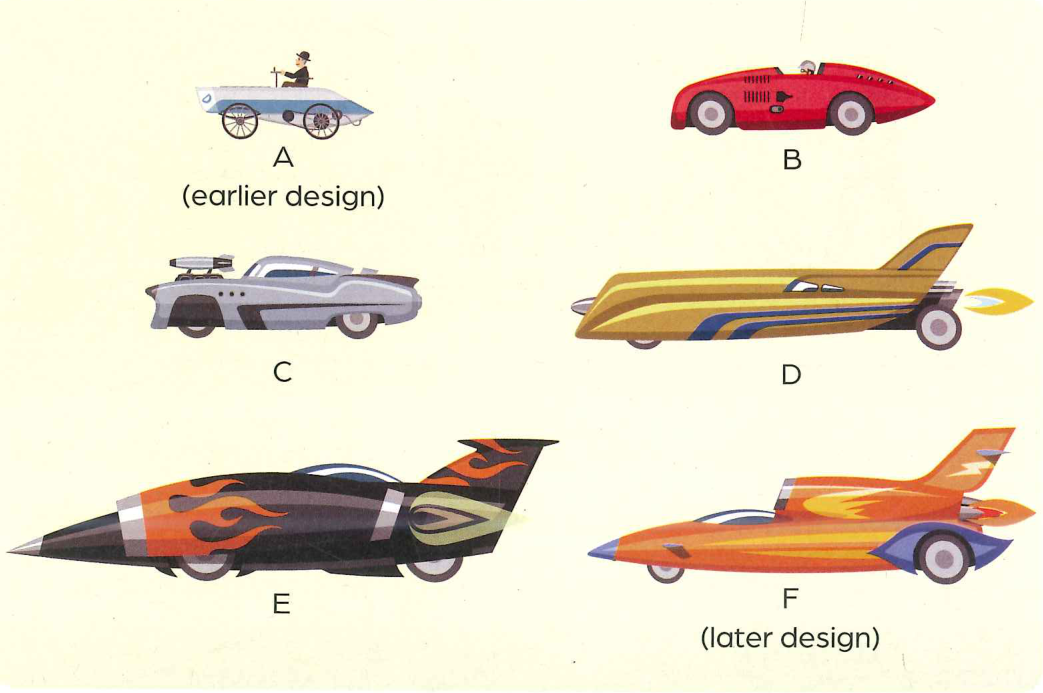
Study the designs of the cars in Figure 8.4. A, B, C, D, E and F are arranged in order of when they were designed; A is the earlier design and F is the later design.
Study the designs of the cars in Figure 8.4. A, B, C, D, E and F are arranged in order of when they were designed; A is the earlier design and F is the later design.
What do you think are the difficulties of trying to break the land speed record?
Study the designs of the cars in Figure 8.4. A, B, C, D, E and F are arranged in order of when they were designed; A is the earlier design and F is the later design.
How do you think they take the measurements to determine the speed?
The Mars Climate Orbiter was a multimillion spacecraft launched by NASA to study the climate on Mars. However, it was destroyed when it accidentally entered the Martian atmosphere. This happened as the engineers who built the spacecraft used imperial units (pounds–seconds) while the NASA team who controlled the mission used metric units (newton–seconds) to calculate the thrust force. This error caused the spacecraft to fly too close to Mars, leading to its crash.
In small groups, discuss the questions and use presentation slides or flipchart paper to present your findings to the class.
What was the main problem that caused the spacecraft to crash?
The Mars Climate Orbiter was a multimillion spacecraft launched by NASA to study the climate on Mars. However, it was destroyed when it accidentally entered the Martian atmosphere. This happened as the engineers who built the spacecraft used imperial units (pounds–seconds) while the NASA team who controlled the mission used metric units (newton–seconds) to calculate the thrust force. This error caused the spacecraft to fly too close to Mars, leading to its crash.
In small groups, discuss the questions and use presentation slides or flipchart paper to present your findings to the class.
Why is it important to use the same units for measurement?
The Mars Climate Orbiter was a multimillion spacecraft launched by NASA to study the climate on Mars. However, it was destroyed when it accidentally entered the Martian atmosphere. This happened as the engineers who built the spacecraft used imperial units (pounds–seconds) while the NASA team who controlled the mission used metric units (newton–seconds) to calculate the thrust force. This error caused the spacecraft to fly too close to Mars, leading to its crash.
In small groups, discuss the questions and use presentation slides or flipchart paper to present your findings to the class.
Give other examples where using the wrong units could lead to problems.
A spacecraft is on a mission to Mars from Earth (Figure 8.8). It travels the first half of the distance at an average speed of 20 000 km/h. After a gravitational boost, it travels the second half at an average speed of 30 000 km/h. The total distance from Earth to Mars at the closest approach is approximately 54.6 million km.
How much faster does the spacecraft travel during the second half of the journey than in the first half?
Share your answers with the class.
[Response format: give the numerical value in km/h.]
A spacecraft is on a mission to Mars from Earth (Figure 8.8). It travels the first half of the distance at an average speed of 20 000 km/h. After a gravitational boost, it travels the second half at an average speed of 30 000 km/h. The total distance from Earth to Mars at the closest approach is approximately 54.6 million km.
What is the average speed of the spacecraft for the journey to Mars?
Share your answers with the class.
[Response format: give the numerical value in km/h.]
A spacecraft is on a mission to Mars from Earth (Figure 8.8). It travels the first half of the distance at an average speed of 20 000 km/h. After a gravitational boost, it travels the second half at an average speed of 30 000 km/h. The total distance from Earth to Mars at the closest approach is approximately 54.6 million km.
The spacecraft returns to Earth following the same speed pattern. What is the total time for the round trip?
At smaller sports events, people use stopwatches to measure the time each athlete takes to complete the race. What are the difficulties when using a stopwatch to measure time at a sports event?
Work in groups to investigate how the shape of an object affects the time it takes to fall.
Design an experiment to test your hypothesis using these guidelines.
- Identify the dependent, independent and control variables.
- Decide which shapes to test.
- Determine the height from which the objects will be dropped.
- Plan how many trials will be conducted for each shape to ensure reliable results.
- Decide how you will collect and record data.
- List the safety precautions you should take.
- Carry out the experiment and record your results.
- Repeat the measurements until the results are similar.