Understanding the tiny building blocks of materials, like atoms in a plastic bottle, helps scientists develop new ways to recycle and reuse them again and again. How do you think this knowledge benefits everyone on Earth?
Have you ever played with plastic building blocks? We can use just a few types of building blocks to build large and complex structures, such as houses, cars and even entire cities!
1. Work in groups.
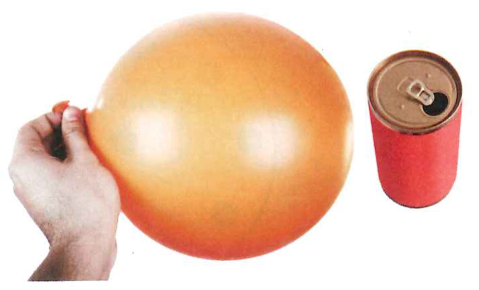
2. Each group member needs an inflated balloon and an empty soda can.
3. Lay down your can on a smooth table or on a hard, smooth, level floor.
4. Rub the balloon against your hair. This causes some electrons to move from your hair to the balloon.
5. Bring the balloon about 2.5 cm away from the can. Move it back and forth to make the can move (Figure 4.4). See whose can moves the fastest.
Caution: Be careful not to burst the balloon. If you do, pick up the pieces and throw them away.
In the investigation, rub an inflated balloon against your hair, then bring it about 2.5 cm from an empty soda can lying on a smooth, level surface. Some electrons move from the hair to the balloon. Discuss these questions in groups.
In the investigation, rub an inflated balloon against your hair, then bring it about 2.5 cm from an empty soda can lying on a smooth, level surface. Some electrons move from the hair to the balloon. Discuss these questions in groups.
What conclusions can you make about how electrically charged particles behave?
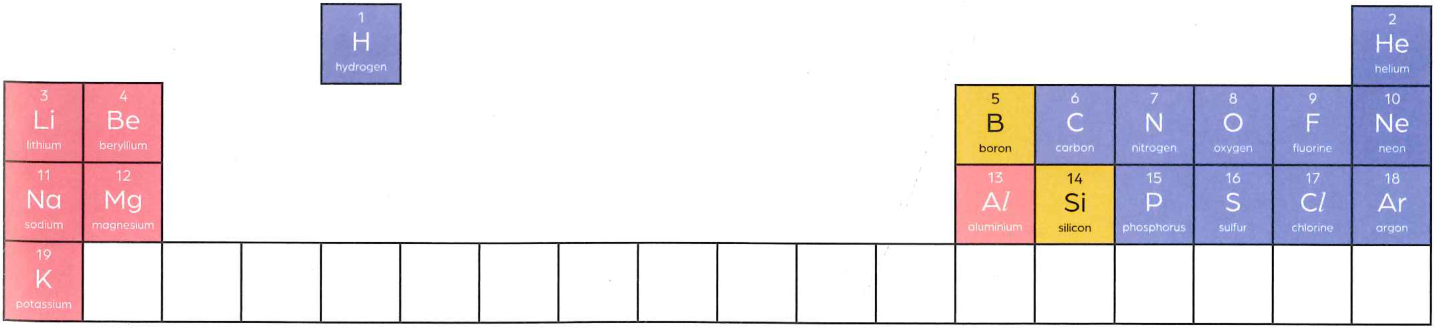
The number of electrons in an atom is the same as the number of protons. Once scientists discovered this fact, do you think they could draw up the Periodic Table and make predictions about the structures of elements that are not yet discovered?
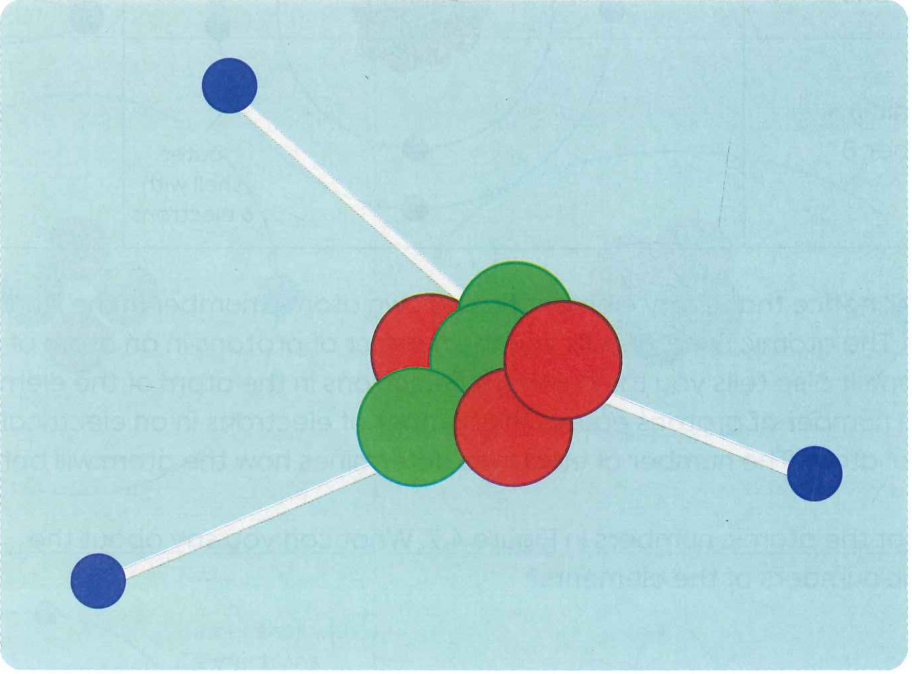
1. In groups, develop a model to show the structure of an atom as in Figure 4.8. You can use toothpicks and modelling clay of three colours, cotton wool or string and so on.
2. Discuss what materials you will use.
3. Choose an element. Pick one from the Periodic Table. Note the number of protons, neutrons and electrons it has.
4. Build the nucleus, showing the correct numbers of neutrons and protons.
5. Arrange the electrons around the nucleus. Remember to add them in the correct shells.
6. Label the chemical symbol, proton, neutron and electron on your model. For instance, you can write the labels on separate pieces of paper and stick the pieces of paper on the model.
7. Present your model to the class.
For hundreds of years, people were unsure of the building blocks of matter. In 1911, Ernest Rutherford came up with the planetary model of an atom. He said that an atom’s structure is similar to the structure of the Solar System. Think back to what you have learnt about this model. In what ways is the Solar System similar to or different from the structure of an atom?