Today, rockets carry satellites, probes and other types of spacecraft into space, to help astronomers answer their questions. However, each rocket launch generates between 300 000 and 400 000 kg of carbon dioxide. This is one of the greenhouse gases responsible for global warming (which is causing climate change). Should we continue launching spacecraft to study space?
Scientists hope to send astronauts to Mars. To do this, they need to develop a large spacecraft (to house a team of astronauts) but they need to make it as light and strong as possible. Discuss in your group why the Mars spacecraft will need to be light.
When the astronauts arrive on Mars, they will feel a different weight compared to being on Earth. What information do you need in order to say if they will feel lighter or heavier? Explain your thinking.
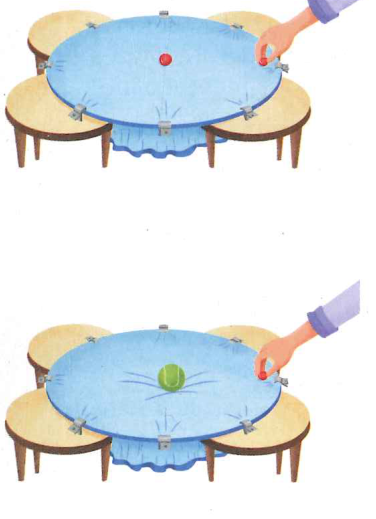
Work in groups to build a model of the gravitational pull between two masses. In this model, the weight of an object on the tablecloth distorts the cloth in a way that models the effect of the gravitational attraction of that object. Place a piece of tablecloth over a hula hoop. Use clips to hold the tablecloth in place. Suspend the hula hoop in some way (as shown in Figure 14.6). Place one marble (or small pebble) in the centre of the tablecloth (Figure 14.6A). Place another marble (small pebble) near its edge. What do you observe?
Work in groups to build a model of the gravitational pull between two masses. In this model, the weight of an object on the tablecloth distorts the cloth in a way that models the effect of the gravitational attraction of that object. Place a piece of tablecloth over a hula hoop. Use clips to hold the tablecloth in place. Suspend the hula hoop in some way (as shown in Figure 14.6). Initially put a marble (or small pebble) in the centre and another near the edge. Repeat step 1. Replace the marble (small pebble) in the centre of the tablecloth with a tennis ball (Figure 14.6B). How does the movement of the marble (small pebble) change?
Work in groups to build a model of the gravitational pull between two masses. In this model, the weight of an object on the tablecloth distorts the cloth in a way that models the effect of the gravitational attraction of that object. Place a piece of tablecloth over a hula hoop. Use clips to hold the tablecloth in place. Suspend the hula hoop in some way (as shown in Figure 14.6). Initially put a marble (or small pebble) in the centre and another near the edge. Now, place the marble (small pebble) much closer to the tennis ball. What do you observe?
Work in groups to build a model of the gravitational pull between two masses. In this model, the weight of an object on the tablecloth distorts the cloth in a way that models the effect of the gravitational attraction of that object. Place a piece of tablecloth over a hula hoop. Use clips to hold the tablecloth in place. Suspend the hula hoop in some way (as shown in Figure 14.6). Initially put a marble (or small pebble) in the centre and another near the edge. What conclusions can you make?
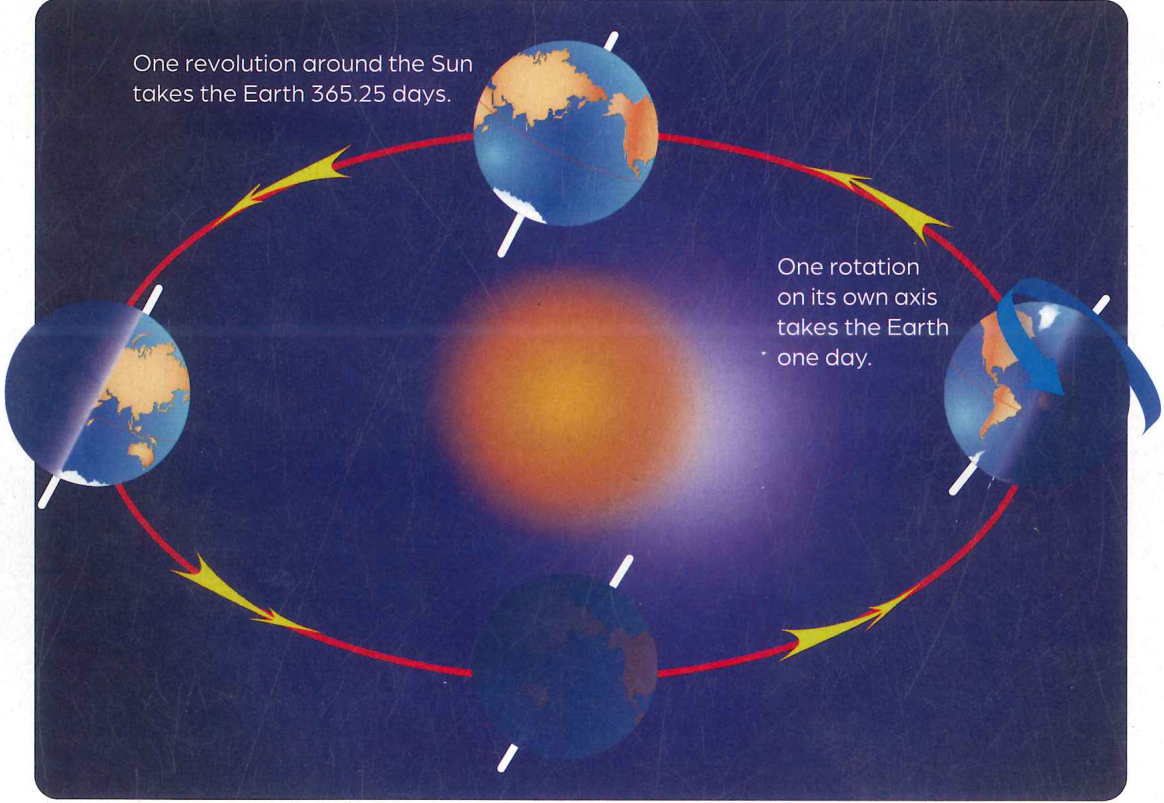
Work in pairs. Look at Figure 14.9. On the far left of the diagram, the Earth is shown in the month of June. The Earth is shown in three more positions. Which month is it in each position?
If you have spent some time at a beach by the sea, you may have watched the water level rise and fall back during the day. Why do you think this happens?
It is useful for aid agencies and governments to be able to predict natural disasters such as flooding. This helps them to prepare. What information is needed to make predictions about flooding?