Question 4
Fireworks are the result of several chemical reactions. When the fuse of a firework is lit, the fire travels along the fuse until it reaches the bottom. This ignites the lift charge, which is made from black powder, a type of gunpowder. The gunpowder explodes, creating heat and gas that cause pressure to build up beneath the shell. When the pressure is great enough, the shell shoots up into the sky.
The diagram shows the energy transfers that are involved when fireworks are set off.
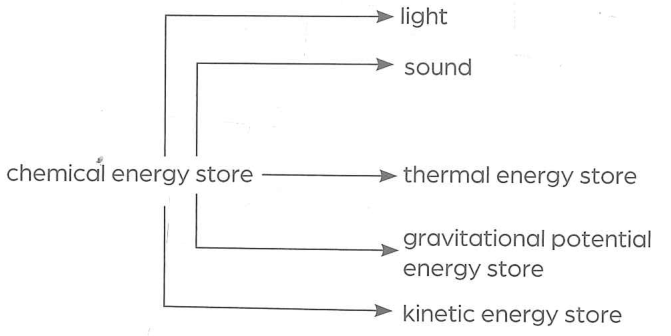
Complete the table to explain how you can tell these energy transfers are happening. The first one has been done as an example.
| Chemical energy store to: | How can you tell? |
|---|---|
| Light | There are bright lights in the sky. |
| Sound | ___ |
| Thermal energy store | ___ |
| Gravitational potential energy store | ___ |
| Kinetic energy store | ___ |
The diagram shows the energy transfers that are involved when fireworks are set off.
Complete the table to explain how you can tell these energy transfers are happening. The first one has been done as an example.
| Chemical energy store to: | How can you tell? |
|---|---|
| Light | There are bright lights in the sky. |
| Sound | ___ |
| Thermal energy store | ___ |
| Gravitational potential energy store | ___ |
| Kinetic energy store | ___ |
