Question 18
Work in pairs or in small groups. Read through the instructions for these investigations (see steps 2 and 3).
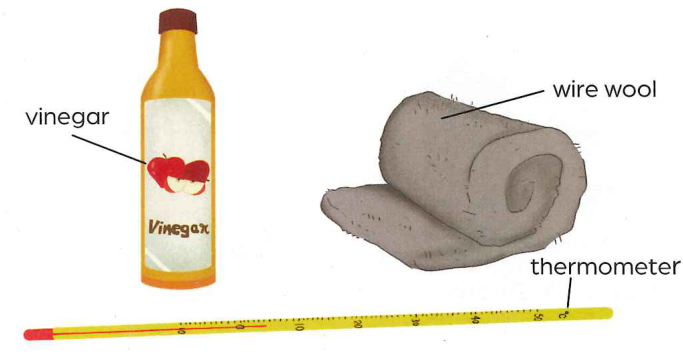
2 Use the materials shown in Figure 7.8 for this investigation.
a Half-fill a beaker with vinegar (ethanoic acid).
b Measure and record the temperature of the vinegar.
c Place a piece of wire wool (made of iron) in the beaker. Make sure it is covered by the vinegar.
d After 10 minutes, push the thermometer gently into the wire wool. Measure and record the temperature of the wire wool.
e What changes do you observe?
f Why does the temperature of the wire wool rise?
g Where does the energy come from?
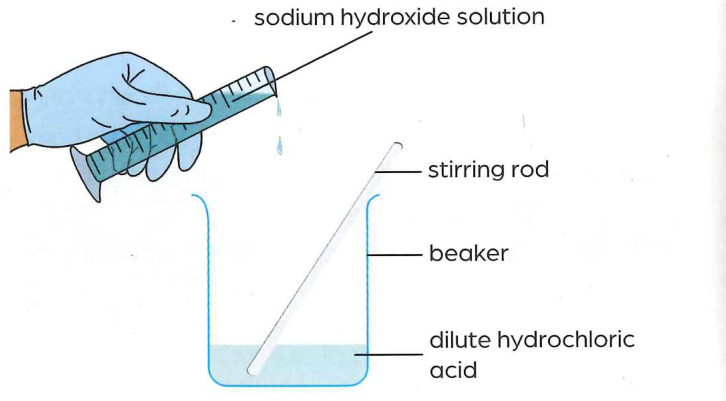
3 Use the materials shown in Figure 7.9 for this investigation.
a Add 10 cm³ of dilute hydrochloric acid in a beaker.
b Measure the temperature of the dilute hydrochloric acid using a thermometer.
c Slowly add 10 cm³ of dilute sodium hydroxide solution to the dilute acid. Stir the mixture gently using a stirring rod.
d Measure the temperature of the mixture. What do you observe?
Caution: Sodium hydroxide is corrosive and can cause severe burns. It is an irritant to the skin and eyes. Wear goggles and gloves when handling this solution.
Answer part 1b: What can you do to work safely?
2 Use the materials shown in Figure 7.8 for this investigation.
a Half-fill a beaker with vinegar (ethanoic acid).
b Measure and record the temperature of the vinegar.
c Place a piece of wire wool (made of iron) in the beaker. Make sure it is covered by the vinegar.
d After 10 minutes, push the thermometer gently into the wire wool. Measure and record the temperature of the wire wool.
e What changes do you observe?
f Why does the temperature of the wire wool rise?
g Where does the energy come from?
3 Use the materials shown in Figure 7.9 for this investigation.
a Add 10 cm³ of dilute hydrochloric acid in a beaker.
b Measure the temperature of the dilute hydrochloric acid using a thermometer.
c Slowly add 10 cm³ of dilute sodium hydroxide solution to the dilute acid. Stir the mixture gently using a stirring rod.
d Measure the temperature of the mixture. What do you observe?
Caution: Sodium hydroxide is corrosive and can cause severe burns. It is an irritant to the skin and eyes. Wear goggles and gloves when handling this solution.
Answer part 1b: What can you do to work safely?
